Wednesday, May 29, 2013

Reality of Maoists

Before we start to speak in the tome of the paid media and the political parties , it is important for all of us to know who actually a Maoist is and what made him do what he is doing today.

In reality they are just common men like anyone of us, some of them are equally educated . The major reason which lead them to this type of a life is the way these political ministers treat the people. The fault is of those people whom we elect.
Today there are very few genuine ministers in the political parties whereas the others are thief's , murderers , liars , rapists and what all. This is indeed very very sad for all of us. We have no genuine person coming ahead to take the command and fulfil all the promises made by him better the elections. If you go deep into the way how these people live you will be shocked to know that these Maoists live a very pathetic lifestyle and there are no efforts done by our government to even listen to them. Our governments use them for their own interests and then leave them alone to die. Later on these people are termed as terrorists and made to be killed so that the reality and the truth is not out in front of the public at large. How shameful it is that we behave like hooligans and then sit for the chair which was once respected but no one knows how much bloodshed helped these people to make one single chair.
If you think this is not the reason then just put 1 question in your mind that why did they target the minister this time and then gave a proof of as to what they wanted and why did the same government of urs didn't take any action before when the innocent men died... ????

KEEP THINKING AND YOU WILL REALISE THE REALITY OF THESE FAKE POLITICIANS SOON....... JAI HIND

Tuesday, May 28, 2013

Increase in Rape dipicts Decline in moral values...

It is shameful to read such articles as on rape on small children and old women... How ruthless animals have we all become which is now being depicted.. Is this what we all wanted , is this the moderanisation and development of what we tal about... Are these the moral values and social duties being performed by the society as well as the government of the so called Indipendent India... Is there nothing that we as a common man or the biggest body , The Supreme court do to help prevent this.. We all know the real cure and punishment for the accused then why are we still treating them as HUMANS.

A simple question which we all must ask ourselves : "Do we think that today what all is going around is right and we are hopless and cant do anything to bring in a change" ? why is that we need a nirbhaya or another guddi or a granny to sacrifise a life so that we become united. Unfortunatly een after this we are not united for more than 3-4weeks.... Which means that now to awaken this blind nation 1 female must sacrifise her life every month.? Is the the respect for women we talk about.. ?
And now our politicians who BEG for VOTES everytime the elections is near, just becaue they get a Vip status they forget who elected them and just fool the people same is the case with the female politicians . No strict action has yet been taken on such a henious crime why ?

The increase in crimes depicts the lack of education. There are no more of moral education lessons being taught in homes, tutions and schools. Which is why the children's mind is now getting filled with dirt and which is leading to such crimes each day. Other reasons to this crime are the misuse of power, the want for more , non satisfaction, being impressed by the outer world, absense of a good culture etc.

Its time that we all look deep inside ourselves and kill the beast in us so that we may soon unite to help clear this crap from this nation along with the accused in this crime and other crimes related to rape like the rape of nation etc.

Saturday, April 20, 2013

What u can do to bring a change ?

The major question arises when we see such a news where women are beaten , organs of a women are damaged after her rape being brutally done , a minor being raped , every common man being crushed with the fake improvement which our government wants to show , increase in a negative western world , increase in frauds and cases of divorce etc. And the question is " ARE WE ACTUALLY HUMAN'S " ?
Because even animals react for there selves but we react 'coz of political wil and then become silent on those thing... Why AND TILL WHEN WILL THIS GO ON...
Nor our paid media , nor the foolish governments of this nation and nor our stupid lawmakers can help is if we ourselves don't want ...
SO TAKE A PLEDGE STAND UP FOR UR RIGHT ... STOP INJUSTICES AROUND U , INPROVE URSELF AND UR NEAR PEOPLES HABBITS , DEMAND THE INCLUSION OF INDIAN MORAL EDUCATION AS A COMPULSARY SUBJECT AJD THE SRORIES BACK IN THE TEXT BOOK OF CHILDREN... FIGHT FOR URSELF ... JAI HIND

Tuesday, March 19, 2013

The Importance of Moral Values in Our Life


Positive moral values are important because they allow you to have an overall feeling of peace and joy. Moral values can give meaning and purpose to your life. You are able to direct your behavior towards beneficial and fulfilling activities.
When you live your life according to moral values that are based on honesty, compassion, courage, modesty, and forgiveness, then you can also form positive bonds with other people.
Incorporating the moral value of honesty in your life make you trustworthy. You will have a clear conscience because you can respect yourself. The people that you come into contact with will be able to count on you to be fair and sincere. Your integrity will allow you to advance in both your personal and professional life. There are more opportunities for you to fully experience life when you are an honest person.
In addition to honesty, you also need to incorporate the moral value of compassion into your life. Compassion allows you to have sympathy for the misfortunes of other people. It also motivates you to want to give them any type of assistance that you can. Compassion results in your having feelings of mercy towards other people. When you have compassion as a moral value people are more likely to put their trust in you because you will be non-judgmental of their circumstances.
Thirdly, the moral value of courage gives you the determination to face anything that impedes your progress through life. You will also be able to overcome any obstacles because you won’t let fear hold you back. Others will feel confident relying on you for encouragement because you find solutions to whatever problems arise in your life. When courage is one of your moral values, you can bravely face the world.
In life it is essential to your survival to have modesty especially in respect to courage. Modesty allows you to realize what your limits are. It helps you to stay focused and keeps you from becoming overconfident and reckless. People will feel comfortable around you because you are humble and you don’t try to belittle them.
Lastly, it is also important to incorporate the moral value of forgiveness in your life. Forgiveness allows you to move past hurtful or damaging situations. It allows you to abandon feelings of anger or resentment against others or yourself. You can be emotionally healthy when you practice forgiveness because it keeps you from holding onto pain and resentment.
In conclusion, moral values are extremely important for your overall well-being. Moral values provide a structure for your life. Honesty makes you respectable. Compassion makes you sympathetic to others. Courage gives you the bravery to overcome life’s challenges. Modesty keeps you focused and humble. Forgiveness allows you to be emotionally stable because you don’t hold onto anger and resentment. These attributes will allow you to live your life in a way that reduces your stress levels. You will also have peace and harmony in your life. Moral values allow you to live your life in a manner that you can be proud of. The bonds that you form with others will also be more fulfilling because you live your life according to honesty, compassion, courage, modesty and forgiveness.

Sunday, February 10, 2013

Biggest problems in Indian education system

There are many problems that are affecting the Indian Education System in a very bad way. Times have changed and along with that the educational needs of the students have also changed. But still we are following the same old study methodology and teaching patterns. This is one of the main reasons why we are lacking behind in our education system.
Another reason is funding. We don’t have sufficient funding either to experiment or to innovate in the field of education. Getting funds for research education and others is a very big problem. Teaching values such as aggressiveness, confidence, withstand competition and verbal ability is not given much prominence at some part.
Another problem in the Indian Education system is the lack of qualified persons. Those who are highly qualified are after good incentives and pay checks and that’s why less qualified persons are taking their places. Ultimately the student becomes the losers in this process.
Those persons who are running the private educational institutions are not highly educated or not working to improvise. Instead, wealthy business persons are starting schools and educational institutions as a means of earning money and as a good business opportunity. They implement systems which are money-worthy and thus the are uneducated even after good teaching.
What good can they do, those who don’t understand the prominence of education system and how it affects the society and students. Study programs are designed keeping in mind the demand for the jobs in the present market scenario. But not keeping in mind the future of the student and the needs of the tomorrow’s society.
All these factors need to be taken into consideration and rectified as per the need. Thus only we can form a better educational system for our future generations


Thursday, January 24, 2013

J.s verma committee report


The three-member committee headed by former Chief Justice J S Verma on Wednesday submitted its 630-page report to the government suggesting amendment of criminal laws to provide for higher punishment to rapists, including those belonging to police and public servants.
Here are some of the recommendations made by the panel which was constituted following national outrage over the December 16 gang rape of a 23-year-old girl in Delhi:
a) New offences have been created and stiffer punishment has been suggested those committing it like leaving the victim in a vegetative state. The new offences include disrobing a woman, voyeurism, stalking and trafficking.

b) The present law provides for punishment for rapists of imprisonment ranging from seven years to life. The Justice Verma committee wants it enhanced to up to 20 years imprisonment for rape and murder and life for gang rape. It, however, refrained from suggesting death penalty.

c) Verma Committee rejected the suggestion of chemical castration of rapists as it considered handing down such a punishment would violate human rights and that mutilation of the body is not permitted under the Constitution. Chemical castration fails to treat the social foundations of rape which is about power and sexually deviant behaviour. Therefore, mandatory chemical castration as a punishment contradicts human rights standards.
d) The panel sought amendments to Section 100 of the Indian Penal Code dealing with the right of private defence, which extends to causing death.

e) Taking note of the brutality committed in the Delhi gang rape incident, the Committee suggested replacement of Section 375 defining rape by defining specific unnatural acts:
1) Intentional touching will constitute the offence of sexual assault for which punishment will be a maximum of five years rigorous imprisonment or fine or both.
2) Use of words, gestures which create an unwelcome threat of sexual nature or advance would invite a maximum punishment of one year imprisonment or fine or both.

3) Voyeurism would be punishable with up to seven years of imprisonment


4) Stalking or attempts to contact a person repeatedly through any means shall be liable to get a term of up to three years
f) Crackdown on khaps. The panel asked, how can khaps, which are unconstitutional, declare a marriage invalid?

g) The judiciary has the primary responsibility of ensuring fundamental rights through constitutional remedies. The CJI can take suo motu cognisance, social activists should assist the court. The Chief Justice of the high court of every state should device appropriate machinery for administration and supervision of these juvenile homes in consultation with experts in the field.
h) All marriages in the country -- irrespective of the personal laws under which such marriages are solemnised -- should mandatorily be registered in the presence of a magistrate and the magistrate will ensure that the marriage has been solemnised without any demand for dowry having been made and that the marriage has taken place with the full and free consent of both partners.
i) Medical examination of victims of sexual assault which were prepared on the basis of the best practices advised by global experts in the field of gynaecology and psychology. 
j) The ambiguity of the responsibility of law and order in Delhi, the reason given publically by the chief minister for the absence of responsibility, must be removed.
k) The panel observed that the "impunity of systematic sexual violence is being legitimised by the armed forces special powers act." It has said there is an imminent need to review the continuance of AFSPA in areas as soon as possible.
l) Politicisation of crime must stop. At present politicians are disqualified for elections if there is conviction; they should be disqualified once cognizance of offence is taken by the court, you don't have to wait for the trial to end.
m) Police reforms a must for preservation of rule of law. Law enforcement agencies must not become tools in the hands of political masters.
n) Run juvenile homes in the spirit envisaged in the Juvenile Justice Act; need a mechanism to run these homes. The panel has noted that juvenile homes have become breeding grounds of all sorts of sex crimes.
o) Trafficking of minor children must be made a serious offence. Trafficking must be punished with rigorous imprisonment for a term which shall not be less than seven years, but which may also extend to 10 years.

p) If any police officer, public servant is found trafficking a child there should be a stricter sentence against him.


Monday, January 7, 2013

On Temples, some little known facts


In 2009, even as the governing body of Tirumala Tirupati was facing questions over 300 missing gold coins, a priest was arrested after confessing to stealing a deity’s two gold necklaces weighing more than a kilo. Governing body officials “said the priest was only a small fry and that there was a larger scam happening at the Lord Balaji temple – which is in possession of jewellery worth more than Rs 45,000 crore”. No inventory of the temple assets, controlled by the government, has been done since 2005. An inquiry in July 2008 by the Vigilance Department of TTD resulted in the suspension of several officials but the findings were never made public.
In 2010, the state government of Orissa apparently sold several hundreds of acres of land belonging to Jagannath Puri temple to Vedanta Foundation at throw-away prices. The matter is now under investigation.
In 2003, the Telugu Desam government in Andhra Pradesh “offered ayurvedic giant Dabur as much as 120 acre of land for a monthly lease of Rs 5,833” (!). The land belonged to Kodanda Rame Swamy templein Chittoor.
In Tamil Nadu, an audit in 2007 of the ancient Parthasarathi Temple in Chennai, managed by the government, revealed that records of seventeen temple grounds (~41000 sq. ft.) in T.Nagar were missing; In addition 11 other grounds had incomplete records and lacked clear titles. The audit also found properties that were let out to non-existing tenants & those that were sold apparently on an ad-hoc basis.
In 2006, A probe conducted by the Justice Tipnis committee on disbursal of surplus funds by Siddhivinayak Temple noted in its report, “the most shocking aspect..is that there is no method or principle followed for particular institutions. The only criteria for selection was recommendation or reference by trustees or the minister or a political heavy-weight, generally belonging to ruling party”
In 2006, Acharya Kishore Kunal, the Religious Trust Administrator in Bihar mentioned that “government control over the temples through its endowment department, has resulted in loss of temple properties worth Rs. 2000 crore”. He was further quoted as saying “the alienation of property has taken place in three ways — sale, lease and forcible occupation by persons with criminal antecedents…several temples, mutts and trusts…over the years have slipped into the hands of criminals masquerading as priests and swamis.“
Down south in Kerala, anecdotal evidence suggests that the extent of donations from the Bhaktas atSabarimala expropriated by the government is such that without them, the government treasury will not be able to break even
This is the story of some of India’s richest temples. This is about the little known fact that they are all controlled by the government. This is a story of “secular” loot. These sacred places of worship and living symbols of our heritage, culture & civilisation that managed to survive centuries of invasions and plunder are today prey to a rapacious government’s systematic loot.
By virtue of control over the Trust Board, the government also controls the surplus funds generated by these temples. Bear in mind that these are some of the richest temples anywhere in the world, not just in India.  What happens to these surplus funds?  The reality is no one quite knows.
All we know is that they are rarely – if ever – diverted back to improving the temple, the facilities, the salaries of priests or for Hindu religious pursuits.  For the most part, they are transferred arbitrarily by the government for “secular”, non-Hindu purposes. The most damaging side-effect of this is lack of resources for maintenance and upkeep of temples, leading to irreparable damage to many medieval and ancient structures
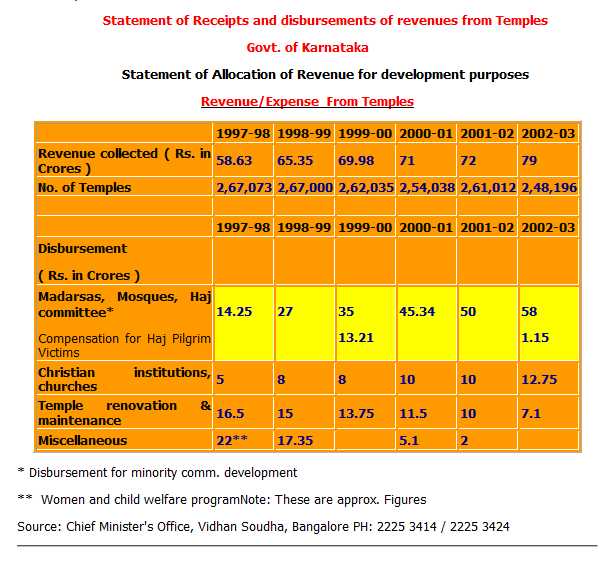
In what may be the most appalling instance of such wilful neglect, disbursements to temples in Karnataka for renovation and maintenance between the period ’97-’98 to ’02-’03, fell (more than halved) from Rs 16.5 crores to Rs 7.1 crores even as revenues collected from these temples rose from Rs 58.63 crores to Rs 79 crores! Interestingly, over the same period, disbursement to Madarsas, Mosques and Haj committee rose more than 4 times from Rs 14.25 crores to Rs 58 crores and disbursement to Christian institutions and churches more than doubled from Rs 5 crores to Rs 12.75 crores.
One of the worst examples of blatant interference in temple affairs was the discovery in Jun ‘12 of a centuries-old temple in a little-known village in Tamil Nadu, managed by government appointed trustees. The temple was badly mutilated in a series of ill-advised construction works. This included the replacement of eastern doors of the temple with new ones that had carved faces of – among others – EVR (who apparently once garlanded ShriRam with a garland of shoes), Mother Teresa, Annadurai and Abdul Kalam.This was not all, the walls were “re-done” with engraving the names of trustees on them.
To the best of my knowledge, such intervention in temple affairs, their management and finances rarely extends to mosques or churches. And where such interference is feared, protest is swift.  Is it a surprise then that the Wakf board is the third-largest landholder after the railways and defence in India? Or that the Catholic Church in India owns the largest chunk of non-agricultural land, and is known to be the second largest employer after the Government of India with an annual budget equal to that of the Indian Navy?
Such brazen interference is also the reason a political leader in Kerala actually had the gall to protest against the government’s decision to only appoint “Hindu MLAs who believe in God” on Devasom Boards on the grounds that such a move is “against the fabric of the Constitution”
But here is the most cruel twist to this sordid state of affairs. While the government shamelessly continues this “loot” of Hindu temples & sacred spaces, political parties, with an eye on votes, compete with each other to provide sops to Imams & Mosques. Thus we had RJD & Trinamool Congress in 2010 demanding the implementation of a Supreme Court order to provide salaries to Imams of government-aided mosques”[viii].
Yes, you read that right.
In this wonderful “secular” country of ours, where the government arrogantly takes over the “right” to manage some of the richest Hindu temples, we actually have “government-aided mosques”, complete with Imams whose salaries are supposed to be paid by the Government. In 2012, the government of Paschim Banga went one step further. It announced that Imams will be “give a monthly honorarium of Rs. 2,500” and “homeless, landless Imams” will be given land to build homes, with the government footing the bill for “construction expenditure” too.
Sadly, most Hindus remain blissfully unaware of all this and of course, no “liberal” will raise their voice on this matter. Should a concerned Hindu mention this in polite conversations, you can safely assume he or she will instantly be branded as “communal”.
Where does this end? And what is the solution?
As always, the first step is to raise awareness about this matter. A vast majority of Hindus – even though otherwise very well-read and well-informed are simply unaware of the monstrosity of government’s control over temples. Many others do not realise the extent of the damage this is causing.
So the first step is to make others aware. The next step is to bring this to the attention of the leaders of Hindu organisation in your area and ask them to challenge this blatantly unconstitutional law in courts. Fortunately things are changing. In Nov ’12, the Hindu Dharma Acharya Sabha (the apex body of Hindu religious leaders) decided to take up this matter. Other activists are gathering information and evidence to challenge these laws in courts. But we have a long way to go – and we cannot afford to be complacent. Why? Because we have not seen the end of this yet.