Thursday, January 24, 2013

J.s verma committee report


The three-member committee headed by former Chief Justice J S Verma on Wednesday submitted its 630-page report to the government suggesting amendment of criminal laws to provide for higher punishment to rapists, including those belonging to police and public servants.
Here are some of the recommendations made by the panel which was constituted following national outrage over the December 16 gang rape of a 23-year-old girl in Delhi:
a) New offences have been created and stiffer punishment has been suggested those committing it like leaving the victim in a vegetative state. The new offences include disrobing a woman, voyeurism, stalking and trafficking.

b) The present law provides for punishment for rapists of imprisonment ranging from seven years to life. The Justice Verma committee wants it enhanced to up to 20 years imprisonment for rape and murder and life for gang rape. It, however, refrained from suggesting death penalty.

c) Verma Committee rejected the suggestion of chemical castration of rapists as it considered handing down such a punishment would violate human rights and that mutilation of the body is not permitted under the Constitution. Chemical castration fails to treat the social foundations of rape which is about power and sexually deviant behaviour. Therefore, mandatory chemical castration as a punishment contradicts human rights standards.
d) The panel sought amendments to Section 100 of the Indian Penal Code dealing with the right of private defence, which extends to causing death.

e) Taking note of the brutality committed in the Delhi gang rape incident, the Committee suggested replacement of Section 375 defining rape by defining specific unnatural acts:
1) Intentional touching will constitute the offence of sexual assault for which punishment will be a maximum of five years rigorous imprisonment or fine or both.
2) Use of words, gestures which create an unwelcome threat of sexual nature or advance would invite a maximum punishment of one year imprisonment or fine or both.

3) Voyeurism would be punishable with up to seven years of imprisonment


4) Stalking or attempts to contact a person repeatedly through any means shall be liable to get a term of up to three years
f) Crackdown on khaps. The panel asked, how can khaps, which are unconstitutional, declare a marriage invalid?

g) The judiciary has the primary responsibility of ensuring fundamental rights through constitutional remedies. The CJI can take suo motu cognisance, social activists should assist the court. The Chief Justice of the high court of every state should device appropriate machinery for administration and supervision of these juvenile homes in consultation with experts in the field.
h) All marriages in the country -- irrespective of the personal laws under which such marriages are solemnised -- should mandatorily be registered in the presence of a magistrate and the magistrate will ensure that the marriage has been solemnised without any demand for dowry having been made and that the marriage has taken place with the full and free consent of both partners.
i) Medical examination of victims of sexual assault which were prepared on the basis of the best practices advised by global experts in the field of gynaecology and psychology. 
j) The ambiguity of the responsibility of law and order in Delhi, the reason given publically by the chief minister for the absence of responsibility, must be removed.
k) The panel observed that the "impunity of systematic sexual violence is being legitimised by the armed forces special powers act." It has said there is an imminent need to review the continuance of AFSPA in areas as soon as possible.
l) Politicisation of crime must stop. At present politicians are disqualified for elections if there is conviction; they should be disqualified once cognizance of offence is taken by the court, you don't have to wait for the trial to end.
m) Police reforms a must for preservation of rule of law. Law enforcement agencies must not become tools in the hands of political masters.
n) Run juvenile homes in the spirit envisaged in the Juvenile Justice Act; need a mechanism to run these homes. The panel has noted that juvenile homes have become breeding grounds of all sorts of sex crimes.
o) Trafficking of minor children must be made a serious offence. Trafficking must be punished with rigorous imprisonment for a term which shall not be less than seven years, but which may also extend to 10 years.

p) If any police officer, public servant is found trafficking a child there should be a stricter sentence against him.



Monday, January 7, 2013

On Temples, some little known facts


In 2009, even as the governing body of Tirumala Tirupati was facing questions over 300 missing gold coins, a priest was arrested after confessing to stealing a deity’s two gold necklaces weighing more than a kilo. Governing body officials “said the priest was only a small fry and that there was a larger scam happening at the Lord Balaji temple – which is in possession of jewellery worth more than Rs 45,000 crore”. No inventory of the temple assets, controlled by the government, has been done since 2005. An inquiry in July 2008 by the Vigilance Department of TTD resulted in the suspension of several officials but the findings were never made public.
In 2010, the state government of Orissa apparently sold several hundreds of acres of land belonging to Jagannath Puri temple to Vedanta Foundation at throw-away prices. The matter is now under investigation.
In 2003, the Telugu Desam government in Andhra Pradesh “offered ayurvedic giant Dabur as much as 120 acre of land for a monthly lease of Rs 5,833” (!). The land belonged to Kodanda Rame Swamy templein Chittoor.
In Tamil Naduan audit in 2007 of the ancient Parthasarathi Temple in Chennai, managed by the government, revealed that records of seventeen temple grounds (~41000 sq. ft.) in T.Nagar were missing; In addition 11 other grounds had incomplete records and lacked clear titles. The audit also found properties that were let out to non-existing tenants & those that were sold apparently on an ad-hoc basis.
In 2006, A probe conducted by the Justice Tipnis committee on disbursal of surplus funds by Siddhivinayak Temple noted in its report, “the most shocking aspect..is that there is no method or principle followed for particular institutions. The only criteria for selection was recommendation or reference by trustees or the minister or a political heavy-weight, generally belonging to ruling party
In 2006, Acharya Kishore Kunal, the Religious Trust Administrator in Bihar mentioned that “government control over the temples through its endowment department, has resulted in loss of temple properties worth Rs. 2000 crore”. He was further quoted as saying “the alienation of property has taken place in three ways — sale, lease and forcible occupation by persons with criminal antecedents…several temples, mutts and trusts…over the years have slipped into the hands of criminals masquerading as priests and swamis.
Down south in Kerala, anecdotal evidence suggests that the extent of donations from the Bhaktas atSabarimala expropriated by the government is such that without them, the government treasury will not be able to break even
This is the story of some of India’s richest temples. This is about the little known fact that they are all controlled by the government. This is a story of “secular” loot. These sacred places of worship and living symbols of our heritage, culture & civilisation that managed to survive centuries of invasions and plunder are today prey to a rapacious government’s systematic loot.
By virtue of control over the Trust Board, the government also controls the surplus funds generated by these temples. Bear in mind that these are some of the richest temples anywhere in the world, not just in India.  What happens to these surplus funds?  The reality is no one quite knows.
All we know is that they are rarely – if ever – diverted back to improving the temple, the facilities, the salaries of priests or for Hindu religious pursuits.  For the most part, they are transferred arbitrarily by the government for “secular”, non-Hindu purposes. The most damaging side-effect of this is lack of resources for maintenance and upkeep of temples, leading to irreparable damage to many medieval and ancient structures
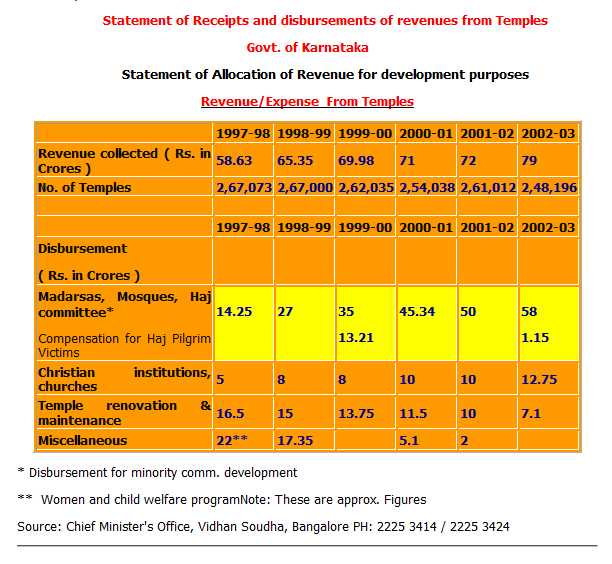
In what may be the most appalling instance of such wilful neglect, disbursements to temples in Karnataka for renovation and maintenance between the period ’97-’98 to ’02-’03, fell (more than halved) from Rs 16.5 crores to Rs 7.1 crores even as revenues collected from these temples rose from Rs 58.63 crores to Rs 79 crores! Interestingly, over the same period, disbursement to Madarsas, Mosques and Haj committee rose more than 4 times from Rs 14.25 crores to Rs 58 crores and disbursement to Christian institutions and churches more than doubled from Rs 5 crores to Rs 12.75 crores.
One of the worst examples of blatant interference in temple affairs was the discovery in Jun ‘12 of a centuries-old temple in a little-known village in Tamil Nadu, managed by government appointed trustees. The temple was badly mutilated in a series of ill-advised construction works. This included the replacement of eastern doors of the temple with new ones that had carved faces of – among others – EVR (who apparently once garlanded ShriRam with a garland of shoes), Mother Teresa, Annadurai and Abdul Kalam.This was not all, the walls were “re-done” with engraving the names of trustees on them.
To the best of my knowledge, such intervention in temple affairs, their management and finances rarely extends to mosques or churches. And where such interference is feared, protest is swift.  Is it a surprise then that the Wakf board is the third-largest landholder after the railways and defence in India? Or that the Catholic Church in India owns the largest chunk of non-agricultural land, and is known to be the second largest employer after the Government of India with an annual budget equal to that of the Indian Navy?
Such brazen interference is also the reason a political leader in Kerala actually had the gall to protest against the government’s decision to only appoint “Hindu MLAs who believe in God” on Devasom Boards on the grounds that such a move is “against the fabric of the Constitution
But here is the most cruel twist to this sordid state of affairs. While the government shamelessly continues this “loot” of Hindu temples & sacred spaces, political parties, with an eye on votes, compete with each other to provide sops to Imams & Mosques. Thus we had RJD & Trinamool Congress in 2010 demanding the implementation of a Supreme Court order to provide salaries to Imams of government-aided mosques”[viii].
Yes, you read that right.
In this wonderful “secular” country of ours, where the government arrogantly takes over the “right” to manage some of the richest Hindu temples, we actually have “government-aided mosques”, complete with Imams whose salaries are supposed to be paid by the Government. In 2012, the government of Paschim Banga went one step further. It announced that Imams will be “give a monthly honorarium of Rs. 2,500” and “homeless, landless Imams” will be given land to build homes, with the government footing the bill for “construction expenditure” too.
Sadly, most Hindus remain blissfully unaware of all this and of course, no “liberal” will raise their voice on this matter. Should a concerned Hindu mention this in polite conversations, you can safely assume he or she will instantly be branded as “communal”.
Where does this end? And what is the solution?
As always, the first step is to raise awareness about this matter. A vast majority of Hindus – even though otherwise very well-read and well-informed are simply unaware of the monstrosity of government’s control over temples. Many others do not realise the extent of the damage this is causing.
So the first step is to make others aware. The next step is to bring this to the attention of the leaders of Hindu organisation in your area and ask them to challenge this blatantly unconstitutional law in courts. Fortunately things are changing. In Nov ’12, the Hindu Dharma Acharya Sabha (the apex body of Hindu religious leaders) decided to take up this matter. Other activists are gathering information and evidence to challenge these laws in courts. But we have a long way to go – and we cannot afford to be complacent. Why? Because we have not seen the end of this yet.

Friday, December 28, 2012

Delhi gang-rape survivor's condition worsens

The condition of the 23-year-old victim of a gruesome gang-rape in Delhi, admitted in a super-speciality hospital here yesterday, has taken a "turn for the worse" tonight with signs of severe organ failure.
"As of 9 pm (6:30 PM IST), the patient's condition has taken a turn for the worse. Her vital signs are deteriorating with signs of severe organ failure," Dr Kelvin Loh, Chief Executive Officer, Mount Elizabeth Hospital said in a statement.
"This is despite doctors fighting for her life including putting her on maximum artificial ventilation support, optimal antibiotic doses as well as stimulants which maximise her body's capability to fight infections," the CEO said.
"Her family members have been informed that her condition has deteriorated and they are currently by her side to encourage and comfort her," he added.
The statement said the hospital's medical team continues to "provide all possible treatment and care", to the victim, who was air-dashed from the Safdarjung Hospital in Delhi for specialised treatment.
He said the the High Commission of India is with her and her family at this critical time.
The girl was gang-raped and brutally assaulted in a moving bus on December 16, triggering massive protests across India and prompting the government to airlift her to the leading multi-organ transplant speciality hospital.
She had undergone three surgeries at the Safdarjung Hospital in Delhi, where she remained on ventilator support during most part of the treatment. Doctors removed major part of her intestines which had become gangrenous.
Earlier in the day, the security was tightened at the hospital, favoured by well-heeled patients, with each visitor screened before being allowed into the ICU.
The victim's father, who flew in with her, said he was reassured that the best is being done for his daughter.
The High Commission of India has assigned a liaison officer with the family.
The girl was shifted to the hospital here following what the Indian government said a "purely a medical decision" taken by doctors.

Saturday, November 24, 2012

Friendship


Friendship is a feeling of love and affection of one person for another. This feeling of love must be reciprocated. Otherwise friendship cannot be possible. Friendship does not exist where tastes, feelings and sentiments are not similar.
The famous essayist Bacon has warned against the friendship between a very rich person and a very poor person. Economic disparity damages friendship. Thus friendship is a feeling of affection between two likeminded persons of uniform status.
It is said that a friend in need is a friend in deed. There may be many friends at the time of prosperity. But most of them desert at the time of adversity. We can examine the sincerity of a friend during our time of hardship and trouble. Only a sincere and faithful friend remains with us at the time of our trouble. All others leave us. It is very painful when our friends turn traitors.
Money is an enemy of friendship. Everybody has an attraction for money. When lending or borrowing of money is done between two friends, there is great risk. Friendship may be affected. So it is wise for true friends to avoid monetary transaction. Vanity is another element which breaks friendship. Everybody has self-respect. When a person tries to criticise his friend, their friendship is affected. So friendship must be treated very delicately.
Very often some hypocrites pretend to be friends. They are more dangerous than avowed enemies. By telling soft words they bring enormous ruin to us. A true friend never exploits. He rather surrenders. But at present, the meaning of friendship has changed.
There are many fair-weathered friends. They terminate their friendly tie as soon as their interests are fulfilled. It is very difficult to find a true friend today. It is better to establish true friendship with either a dog or an elephant. Both these beasts will remain faithful to their human friends. Today, friendship between two persons is short-lived.
Good friends exercise good influence. They always help their friends, in distress and inspire them to walk on the right path. But evil friends ruin us completely.

Saturday, November 10, 2012

All religions are equal


I do not follow anyone or anything in life blindly. Your problems and success are a result of your actions and hard work, so have faith in yourself. Life throws surprises at you in different ways, and taking it in your stride with a positive attitude is a way to be at peace.
I'm a spiritual person, a seeker of knowledge beyond clich?d religious beliefs. I believe in thinking and doing good things. Many people do all the wrong things in life and seek redemption by praying. However, I don't think that is the right approach for me. I don't get into a zone of believing that if don't pray, I will be a sinner or bad things will happen to me, that's a very naive approach which most of the world follows. I'd rather live and let live, and be at peace with myself by analysing my thoughts and actions.
I don't really pray everyday, but being a sikh, I believe in the right actions. I do meditate sometimes to connect with that higher soul and ask for his forgiveness and blessings, and to guide me to the path of good deeds and positive thoughts.
I am very secular and have visited shrines of different religions. You can go to any place of worship and not consider one to be more important than the other. I have been to the Golden Temple, Vaishno Devi, Ajmer Sharif, Tirupati Balaji and many more. Many times I wish to go to the Haji Ali dargah and Siddhivinayak temple in Mumbai, and when I go to Delhi, I wish to visit the Bangla Sahib Gurudwara and the Nizammudin dargah. In the future, I would love to visit the Vatican. I take blessings from the teachings of various religious books as all of them convey the same message and extol the same virtues. I feel that all religions are equal.
I am not superstitious at all. I don't believe in lucky colors . I do and follow pleases me, my cars are all different in color just because that color pleased my eye when i saw it and not because it is lucky or something..
I connect with my inner self by clearing my conscience. I believe in the 'live and let live' policy and not being judgmental about others. What can be right for me, could be wrong for someone else, so each to his own. I learn from all my past mistakes and have faith in my actions. It's your belief and faith in your deeds that takes you forward in life.

Sunday, November 4, 2012

Unity in Diversity

Ever wondered at the diversity in Culture of India? The enticing unity represented by the people of the country who display a wide range of religions, culture, customs and languages. The rich and varied heritage happens to be one of the many sources of pride of the nation. The mysterious ways of the people, their lifestyles and the inseparable culture of India cannot be done solved in words but can surely be enjoyed with experience.

The land of the kings, Rajasthan, promises to be an experience of a lifetime with its wealth of culture and traditions.

The arts and crafts, music and dance, architecture and people all are instances of the culture and its rainbow of India. The trip to Rajasthan offers unique sights like the architectural magnificence of the forts and palaces. Joy rides on elephants cannot be compared to the ride in the BMW. The women from Rajasthan in brightly colored clothes, wearing tons of jewelry and the huge turbans adorned by the men are examples of the diversity of culture in India. The picturesque dunes, the enigma of the beautifully built palace.

s andThe pure white elegy of love, Taj Mahal, if viewed on a full moon night leaves a mark in the memory so does the masterpiece in red stand stone the Red Fort. The tomb of Itmad-ud-Daula is another spot to be visited by the tourists for its design.

Down south Culture of India in each city is associated with a specialty. The port city of Mahabalipuram is renowned for its rock-cut monuments, structures in a single stone and bas-reliefs besides its beaches. The Kamakshi Amman temple and the Varadaraja Perumal temples in Kanchipuram are must a visit for the travelers to the cultural destination. The beauty and elegance of the silk saris available need no mention. The silk industry happens to be centuries old, and famed the world over. Make sure to pick up the Kanjivaram saris for gifting purposes to your family and friends from the strech of silk shops along the Gandhi Road. The trip to trichy reveals the beauty of the ancient culture of India through the architecture in its temples and monuments. The Rock Fort temple, with exclusive rights of 'darshan' to the Hindus and the temple complex of Ranganathar are amongst the many places of interest in the city. The view of the river Kaveri is another mesmerizing experience.

The most happening culture of India in the south happens to be the city of Madurai. The city situated on the banks of the river Vaigai is famed for the Meenakshi temple. The temple is dedicated to Lord Shiva one of the trinity. The other places of the interest for culture in India include the Thirumala Nayak palace, an example of the architectural heritage. Close by is Tanjore or Thanjavoor, famous for its paintings and arts. The visit to the Brihadeshwara temple will complete the trip to the marvel of the Chola architecture.
Besides the pious travelers and admirers of architectural beauty, the trip down South will be unforgettable for the nature lovers. The wildlife sanctuary at Periyar happens to be a tiger reserve too. It is a haven for the terrestrial, aquatic and arboreal animals besides the rare flora and fauna. the atmosphere

While experiencing the diversity of culture in India, one cannot miss the destination of Cochin. The port town offers a range of tourist spots. Right from the island palace of Bolghatty to the St. Francis church. The town boasts of the Chinese fishing nets, unique throughout India. Besides the nets, the Chinese tiles and the Belgian chandeliers are major attractions at the Jewish synagogue. The St. Francis church besides being the oldest church built by the Europeans is a travel spot because of being the burial site of the great explorer Vasco Da Gama. The fast changing and happening city of Bangalore and the royal city Mysore are other places displaying the richness of culture of India.
In case you are planning for a holiday, the idea to explore the heritage of culture in India will be an excellent option. The diversity of the land is immense to make us realize the number of years that have gone into beautifying each aspect of culture. The Culture holidays in India are an effort to pick up the best possible flavors of the land and offer them to the tourists in a package.ere of the cities of Rajasthan are few features of the culturally astounding state.

Saturday, October 27, 2012

The Young Indian Politicians

We all have heard and known the fact that “Controversies Sells”! If this term is added to the Indian politics, the issue is blown out of proportion. Now, if we have the names of those belonging to India’s first political family, it is definitely more than a spark. And so, Rahul Gandhi is in for a row of controversies for his remarks on the Rashtriya Swayamsevak Sangh (RSS).

Junior Gandhi has always been known to do and approach things very differently. However, it is not necessary for people to like this all the time. But then, he manages to be in the news all the time, which is proved yet again.
We all know that comparing and equating the RSS to an outlawed and banned organization like that of SIMI (Students Islamic Movement of India) would not be taken lightly by the concerned people. Keeping aside controversies, the RSS took a different approach towards these remarks. Instead, they decided to educate the Gandhi scion about their organization. Six books were sent to Junior Gandhi so that he broadens his realm of knowledge when it comes to this youth wing of BJP. This does not mean that they have not demanded an apology. They have also termed these remarks as being disappointing and unwarranted.
For the common masses like us, this can easily be easily considered as another stint to remain in the public eye and like always, to gain more publicity and get more votes in return when the time calls for it. Obviously, someone like Rahul Gandhi cannot be so ignorant to make such a careless remark. As always, each and every action has a motive. But in this case, only time would tell the motive behind such a statement.
Intended or not, Rahul Gandhi is happily being discussed in the Parliament with the opposition claiming him to be still naïve and is not matured enough when it comes to Indian politics. Some have even considered the idea that he has lost his mental balance.
On the other hand, Indian Politics has its own way to function. It would seem incomplete without a decent amount of scoops for controversies. So, coming back to the Ruling Party, none seem be regretting what has been said and done. Instead, all the leaders seem to be supporting the incident. And so, the real game begins as all the toadies are in to impress the Congress President Sonia Gandhi. Of all the people, we have someone like Digvijay Singh justifying this statement which clearly portrays nothing more than “chamchagiri”.
But then, we are not novice to Indian politics…morality counts nowhere, all that matters is filling up the vote bank! This could only be done if the minority community supports him.
However, the question is whether this was the last route left for him to gain support? I am sure a brainstorming on ideas would have definitely led to better results. It seems as if the Indian mentality of rushing into things comes into picture here. There are many social issues which could have easily led the other communities to lend their support. So, what made him stop from using his brain? It seems as if the Indian way of playing politics is slowly catching up with this Gandhi.
Another similar instance is that of Omar Abdullah who gave an anti-India speech which was supported by Rahul Gandhi. So, the major question is which way are these young politicians going? Are they really different from their predecessors?