Saturday, September 14, 2013

Are Indian hospitals so bad.... ?

I would generally not like to comment on an issue when it concerns someone’s treatment. Heaven forbid, none should fall so ill that the treatment isn’t even available in the country. Everyone would like to be treated closer home, and as quickly as possible. But doesn’t it make you wonder? India is rated as one of the few nations in the world that are seeing a surge in medical tourism. In fact, the politicians, and indeed these babus themselves, do not tire of proudly claiming how the number of foreigners who come to India for treatment and how happy they were not just with the quality of treatment and post care, but also how it cost them a fraction of what it would have back home. Newspapers are full of such stories. It is a fact that some hospitals have special rooms with facilities that can put a five star hotel to shame, to explicitly cater to the super-rich patients from the gulf, for example.

If it is very good for others, mostly due to it being cost effective, where on earth is the need for our babus to rush abroad? Of course, the government can turn around and say these are the crème-de-la-crème of the nation’s civil services, so critical for providing quality governance to a democratic nation, and a big and powerful nation like ours can afford to look after its brightest.

Sure, but this would be fine if we actually lacked in quality medical facilities. Everyone knows that at least the metros now have facilities that are on a par with any. In fact, a number of illustrious doctors who have spent a long time in the hospitals abroad have started homing in to these facilities, for the want to be able to practise in India at facilities that were unheard of when they left the shores years ago.

This decision therefore, is simply not on. It is like rubbing salt on the already deep wounds of the common man, squeezed dry by the misgovernance by these very babus lorded over by corrupt politicians.

The government may say it is not something that is done at anyone’s whims, but will be subject to a screening committee. But, we know how anything would ultimately work, especially when the screening committee members would themselves perhaps have some vested interests or be beneficiary of the scheme. Why should I, the tax payer, be paying for a babu’s procedure when a heart surgery in India, at a decent place, costs just over $1.5 K while a similar procedure in the US may cost over $100 K?


No! This can’t be acceptable. Tomorrow you may come up with a plan to send babus’ kids abroad for education because the quality is not good in India. There is no end to what other nonsense their minds can throw up.

All these are the easy ways out. If they had any sense, they would spend the budget being earmarked for such wasteful/needless activities on providing similar facilities at more hospitals in India so that they are accessible to more of ‘their’ countrymen.

But do you think they will reverse this decision? Like most others, I have my doubts. As an editorial in Frankfurter Allgemeine in Germany said recently: India has never had it so bad. Stealing in government has never been this brazen. Government officials are now so audacious in their corrupt practices that they do not give a damn about who is watching.

If they don’t care about what the Germans say, fat chance our rants would have any impact. Not yet, but they should brace themselves for something big that hurts, and soon. For, their shamelessness and brazenness is now crossing the limits that even the extremely patient masses of this nation may find difficult to ignore for too long.

Monday, September 9, 2013

Articles By Gandhi on Hindu-Muslim Unity....

Articles By GandhiHindu-Muslim UnityMay 11, 1921

That unity is strength is not merely a copybook maxim but a rule of life is in no case so clearly illustrated as in the problem of Hindu-Muslim unity. Divided we must fall. Any third power may easily enslave India so long as we Hindus and Mussulmans are ready to cut each others' throats. Hindu-Muslim unity means not unity only between Hindus and Mussulmans, but between all those who believe India to be their home, no matter to what faith they belong.
I am fully aware that we have not yet attained that unity to such an extent as to bear any strain. It is a daily-growing plant, as yet in delicate infancy, requiring special care and attention. The thing became clear in Nellore when the problem conforonted me in a concrete shape. The relations between the two were none too happy. They fought only about two years ago over the question of playing music whilst passing mosques. I hold that we may not dignify every trifle into a matter of deep religious importance. Therefore a Hindu may not insist on playing music whilst passing a mosque. He may not even quote precedents in his own or any other place for the sake of playing music. It is not a matter of vital importance for him to play music whilst passing 'a mosque. One can easily appreciate the Mussulman sentiment of having solemn silence near a mosque the whole of the twenty-four hours. What is a non-essential to a Hindu may be an essential to a Mussalman. And in all non-essential matters a Hindu must yield for the asking. It is criminal folly to quarrel over trivialities. The unity we desire will last only if we Cultivate a yielding and a charitable disposition towards one another. The cow is as dear as life to a Hindu; the Mussulinan should therefore voluntarily accommodate his Hindu brother. Silence at his prayer is a precious thing for a Mussulman. Every Hindu should voluntarily respect his Mussulman's brother's sentiment. This however is a counsel of perfection. There are nasty Hindus as there are nasty Mussulmans who would pick a quarrel for nothing. For these we must provide panchayats of unimpeachable probity and imperturbability whose decisions must be binding on both parties. Public opinion should be cultivated in favour of the decisions of such panchayats so that no one would question them.


I know that there is much too much distrust of one another as yet. Many Hindus distrust Mussulman honesty. They believe that Swaraj means Mussulman Raj, for they argue that without the British, Mussulmans of India will aid Mussulman power to build a Mussulman empire in India. Mussulmans on the other hand fear that the Hindus, being in an overwhelming majority, will smother them. Such an attitude of mind betokens impotence on either's part. If not their nobility, their desire to live in peace would dictate a policy of mutual trust and forbearance. There is nothing in either religion to keep the two apart. The days of forcible conversion are gone. Save for the cow, Hindus can have no ground for quarrel with Mussulmans. The latter are under no religious obligation to slaughter a cow. The fact is we have never before now endeavoured to come together to adjust our differences and to live as friends bound to one another as children of the same sacred soil. We have both now an opportunity of a lifetime. The Khilafat question will not recur for another hundred years. If the Hindus wish to cultivate eternal friendship with the Mussulmans, they must perish with them in the attempt to vindicate the honour of Islam.

Tuesday, August 27, 2013

Calculations of votes...

 Read this carefully and act wisely remember we going through a bad phase of the country's future and the next generation will not pardon us for the glaring mistakes that we commit in the name of secularism ** **   * Read carefully again and again, and understand! Reasons why Congress is winning for the past 65 years and why it will win in the future: (A view Point) Currently, on an average (over states) there are: 15% Muslims, 8% Christians, 7% Others and 70% Hindus. That means: out of 100 people, there are 70 Hindus, 8 Christians, 15 Muslims and 7 others. Voter registration is as follows: 90% of Muslims, 90% Christians and 60% Hindus and 90% Others. This means: out of 100 people, 42 Hindus, 14 Muslims, 7 Christians and 6 'Others' will register for vote. Now, interesting point Out of the registered voters having voter ID or at least having interest in selecting their representative. Have a look at the number of turnouts: 50% Hindus will vote, 90% Muslims will vote, 90% Christians will vote and 90% others will vote. This means: Ultimately 21 Hindus will vote, 13 Muslims will vote, 6 Christians and 5 'Others' will vote during* *election and these 45 (45%) people are responsible for selecting the representative and deciding the future* *of our dear Great mother land (*****India****!!!) Now see Out of these 45 people of total population who votes for whom! It is highly likely that out of 13 Muslims, 10 will vote for Congress, Out of 6 Christians, 5 will vote for Congress and Out of 5 others, 3 will vote for congress. it means: Congress will get 18 non Hindu votes, BJP may get 1 Muslim or Christian and 1 others vote. So what BJP has got? BJP has got 2 non Hindu votes! Other parties, that are third front, may get 2 Muslim or Christian and 1 vote from others. That is, 'Others'**** *may get 3 non Hindu votes. VERY IMPORTANT

Coming to Hindu votes: Out of 21 Hindus. > If 5 vote for Congress, 10 vote for BJP and 6 vote for other parties Final result will be: Congress 23 votes, BJP 12 votes, other parties will get 9 votes. This has been the trend since 1990, therefore, Congress do not bother for Hindu votes!!!! Congress loses in States where the Muslims do not vote for them. If Congress scares minority from majority, which is easy in the name of burka "secularism",* *their 90% work is done........* *and they have been doing so religiously......... It is highly likely that the trend will continue and may vary by few percent and the Congress will remain in Power, as minority population increases, for the next 100 years.. So what is the Mantra to thrash congress and defeat Islamic Terrorism? 1. Register yourself for Voter ID; 2. Get the Voter ID as soon as possible; 3. Do not go for picnic and picture during Election Day; 4. Vote for nationalist and patriotic leader like Narendra Modi on Election Day; 5. Islamic terrorism is growing rapidly and soon enter into *****India****with a bang! if we will celebrate the picnic and go for picture on election day, our children will not be alive to celebrate all these nice moments! Our dear mother land is calling us, vote this time, and save it from Jihad! Share it with as many as people you can!**** * * * *  ** **

Sunday, August 25, 2013

The need of Today to strengthen a country is UNITY of its ppl...

When a work is done united for obtaining any special goal is called unity. It is a significant feature in human life. Without unity we cannot do a single day.

The necessity of unity in human life beggars description. Unity has great value in every walk of life. It is related to our existence. There is a proverb that unity is strength. Therefore, our first and foremost duty is to maintain unity of our life. We cannot do a single day without the help of others. In addition, the help of others depends on unity. Being united, many difficult tasks can easily be done within short time. There are thousands of problems in man’s life. To solve these problems, united effort is essential. Unity helps a nation to reach the goal. Unity is essential to save any country and countrymen.  


The results of unity are many. People can enjoy a tension free life living united in the society. It is said that ‘united we stand, divide we fall’. It is true that we can break a single stick easily. On the other hand, to break a bundle of stick is really difficult or impossible. Thus, we can realize the value of unity. It is very significant in trade and commerce. Because, different countries of the world make trade union to lead a good trade among their own. Unity is a powerful weapon to be successful in trade and commerce. It is said that without unity to run trade and commerce is impossible. It is true that to gain any kind of freedom without struggle is not possible. For this, unity is must.

The effects of unity in national life are very significant. Today we can observe the merits of unity among the developed countries in the world. In a word, to live successfully in this world unity is must.

There are many bad effects of discord. A nation without unity is considered as a weak nation. A nation cannot stand upright without unity. To be united, personal and national selfishness must be abandoned. For living united, we have to take lesson from the history. In the past, many nation and community ruined due to discord. Unity saves us from thieving, robbery, smuggling, hoarding and mischief.
In the time of flood, cyclone, drought, earthquake etc. people suffer a lot. They need help then. To help them united efforts is must. Therefore, to run voluntary activity unity is essential.   

For the development of a country united efforts is must. Without unity a country cannot run. Therefore, for the betterment of the country and countrymen, we have to live united.

Saturday, July 27, 2013

When the iron's cold

Among the several questions that could have been asked at the prime minister's media conference - but weren't - one omission stood out for how interestingly it captures our malleable emotions. There wasn't a single question about Pakistan. 
 
There were questions on the turmoil in Egypt; even on cricket and the World Cup. But no one, it seems, wanted to quiz Manmohan Singh on what led to the resumption of the dialogue process with Pakistan earlier this month in Thimphu, Bhutan. And unlike the forgotten query on the controversy surrounding the appointment of the central vigilance commissioner, the absence of questions on Pakistan appeared to be from disinterest - not oversight. In other words, we are so distracted by domestic concerns that Pakistan is barely on our minds. Of course, the fact that there has been no major terror strike or volatility in the internal security situation has much to do with our lack of focus. But the truth is that if we - the polity, the media and the people at large - were not so preoccupied by the sense of churn within, the resumption of the talks with Islamabad would have invited the same merciless scrutiny as it has in the past. In fact, Pakistan is so off our collective radar that we've barely noticed the exit of the establishment's bete noire: the bumptious, often abrasive, Shah Mahmood Qureshi.

What makes things interesting is that the Pakistani mindspace seems to be just as distracted. As the assassination of Salman Taseer reminded us, Pakistan's internal implosions are, of course, existential challenges. Despite the avowed India-fixation of General Ashfaq Parvez Kayani, in many ways, Pakistan today seems more at war with itself than with India. With competing philosophies and groups laying claim to the country's future, the cracks along its faultlines are deepening. 

Currently spooked by spy games that Washington is playing in its backyard, the growing domestic controversy over Raymond Davis (an American arrested for shooting two Pakistanis; he claims in self-defence) only underlines the divisions within the country's ruling establishment over how to navigate the minefields on its journey forward as a country.

Some say Qureshi lost his job as foreign minister for asserting that Davis never had the diplomatic status the Americans are now claiming. Others argue that Qureshi is only playing to the growling anti-American chorus with his proclamations, in case there is an early election. The whispers suggest that Davis is a CIA contractor collecting information on the Lashkar-e-Tayyeba and a deal has already been struck by the Pakistan Peoples Party (PPP) government to pave the way for him to be handed back to the Americans. Either way, Pakistan's media are focused on the turmoil within. Even Kashmir hardly seems to inflame passions in the same way. So much so that Pakistan's annual marking of Kashmir 'solidarity day' on the eve of the meeting between the two foreign secretaries in Thimphu seemed more ritualistic than felt, and passed without much hoopla on either side.

Ironically, this emotional indifference may provide the best opportunity we have had in a long time for a dispassionate review of the India-Pakistan equation. For too long now, both countries have been trapped in a dysfunctional drama that alternates between love and hate. The schizophrenia has resulted in a deep-seated hostility at times and inexplicable bursts of affection at other moments. Remember the roar of applause when the Pakistani contingent marched in during the opening ceremony of the Commonwealth Games? Too many Indo-Pak meetings feed the subcontinental craving for filmy drama right down to slammed doors and jostling over joint statements that never were.

The best thing the two foreign secretaries did for the dialogue process was to save it from the curious and contradictory love-hate melodrama that has defined similar meetings in the past. The future of the two countries belongs neither to the candle-waving romantics who convene at Wagah nor to the venom-spewing hatemongers who unleash their bitterness online (while, of course, befriending every Pakistani possible on Twitter). It belongs to the 'pragmatics' - to borrow a word from Nirupama Rao - who are able to see Pakistan beyond the Punjabi prism of the painful past.

Almost unnoticed and unacknowledged is the remarkable fact that Kashmir is no longer the main obstruction to peace between the two countries. Pakistan's former foreign minister Khurshid Mahmud Kasuri has elaborated on the contours of a Kashmir settlement that had the nod of what he calls "all the principal players". He includes in this category, the present army chief of his country. Interestingly, we have seen neither a denial nor a confirmation of his assertions by our own government, with the foreign secretary only offering a "no comment" in a recent interview. But all other things being equal, a broad philosophical consensus does exist on what a possible solution could be to the longstanding Kashmir problem. And it still borrows from the essential template created by President Pervez Musharraf's four-point formula.

That's the good news.

The bad news is that in many ways the challenge of  terrorism is much more intractable than the Kashmir dispute. The 26/11 strikes had precious little to do with the politics of the Kashmir problem. Violence perpetrated against India, its cities and its people by fundamentalist religious groups is now the primary hurdle to cross for peace to have any real meaning. And many doubt that Pakistan's civilian government has the strength, even if it has the will, to do so. With emotions at an ebb on both sides, it's a good time to find out.

Friday, July 19, 2013

Might this be the real cause of Muslim “backwardness”?

Only one out of every six Muslim children entering an Indian school stays till his matriculation. I use “his” deliberately; the figures are worse for girls—only two out of five Muslim girls enter schools, and fewer than one-tenth complete secondary education.
These stark dropout rates explain the malaise affecting Indian Muslims, and unless that’s addressed, all other solutions are ineffective.
Such low enrolment figures and high dropout rates mean that only one of 25 undergraduate students, and barely one out of 50 postgraduate students in Indian universities, is a Muslim. India defines literacy rather generously, and yet Muslim literacy rate is only 59.1%. According to the Rajinder Sachar committee’s report in 2006, Muslim enrolment at the Indian Institutes of Management was 1.3%, and at the Indian Institutes of Technology, out of 27,161 students, only 894, or some 3.3%, were Muslim.
The consequence? Inevitably restricted professional opportunities. Just about 5% of applicants for the civil service examinations are Muslim, and of the elite bureaucracy, only 3% of Indian Administrative Services, 1.8% of the Indian Foreign Service, and 4% of the Indian Police Service, are Muslim. The figures improve marginally in other government departments, but only just. Muslims form 4.5% of employees in the railways, and an astonishing 98.7% of them are employed at lower levels. In other departments, such as education, health, and transport, representation varies between 4% and 7% of the total number of employees.
Lacking education and skills, many Muslim men and women find it hard to get jobs, and many end up being self-employed. While 44% of Muslim women are economically active (in itself a low figure) only 25% work outside their homes. Many men work in small businesses. Such jobs typically have minimal protection—no unions, poor work conditions, limited probability of training or advancement and low wages.
Even if they become entrepreneurs, credit may be hard to access without paper qualifications. Figures bear that out: the loans that average Muslim borrowers get are smaller than the loans others get. Furthermore, between 2000 and 2006, of the Rs. 266 billion that the Small Industries Development Bank of India disbursed, Muslims received only Rs. 1.24 billion…
And what does the government do? It “promises” to keep madrassas outside the purview of the RTE Act, thus making sure that there is no move to reform and formalise madrassa education . As the report (in the link notes):
Almost 90% of underprivileged Muslim children attend madrassas. However, devoid of a modern curriculum, madrassas are unable to equip these students for the contemporary job market.  This in turn limits their economic opportunities. By bringing madrassas under the provisions of the RTE Act, the Islamic seminaries will be forced to submit to universal standards and modernise.

Tuesday, July 9, 2013

A Brief History of the Sino-Indian Border Dispute and the role of Tibet


On the 3rd of July, 1914, as Ivan Chen made his way down the steps of the Summit Hall building in Simla, he must have been aware of mixed feelings rising up inside him.  He had done something which would have far-reaching repercussions; and which would for years be remembered by many people on both sides of the Sino-Indian border, albeit in very different ways - He had just left the Simla conference.
After refusing to sign the agreement himself, he was made to sit in a separate room, and behind his back, was signed  one of the most controversial and bizarre treaties in human history – The Simla accord.

For over a century, the intricacies of the border between India and China have baffled scholars. The plot leading to the Simla conference and beyond is a textbook example of diplomacy and back-handed politics at work, and plays just like a thrillerbook or movie. The sheer complexity of this problem can be judged by the fact that 36 rounds of negotiations have taken place between India and China at different levels since 1981; but they have yet to reach a settlement.
 

Background

The era of the late 19th century and the early 20th century was ripe with the European colonial powers finding new ways of exerting their influence in Asia and dividing it up.
Tibet was no exception. For years, many kings and empires, from Muhammad Tukluq to the British, had tried to wrench Tibet from China, with no significant successes.
Finally, the British came up with an underhand ploy to divide Tibet from within; so as to create a buffer state between British India and China; just as Mongolia had been divided and part of it made into a buffer between Russia and China. Sir Henry McMahon proposed the division of Tibet into an ‘inner’ and ‘outer’ Tibet. The Chinese representative saw through British imperial designs and smelt a rat; and thus left the Simla conference.


But the matter didn’t end there. A note was appended to the Simla accord, thatcontained a map  showing a part of Tibetan (i.e. Chinese) territory as Indian, based on a thick red line known as the McMahon line. Furthermore, China was barred from any rights and privileges of the Accord with respect to Tibet.

Disputed Territories

The major territories disputed between these two countries can be divided into two distinct parts:

1) The Western Sector - Aksai Chin, which lies to the east of the Kashmir valley, covering an area of about 37,250 sq.km (14,380 sq.mi) - currently occupied by China.
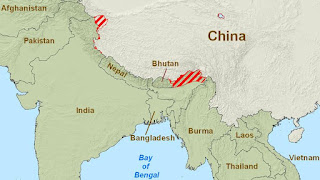
Territories disputed between India and China

2) The Eastern Sector - Most of the Indian state of Arunachal Pradesh, that China calls South Tibet, covering an area of 83,743 sq.km (32,333 sq.mi) - currently occupied by India.

In addition to these, there are also a few small chunks of territory in between these two sectors, but they are largely irrelevant when compared to these two major distinct territories.

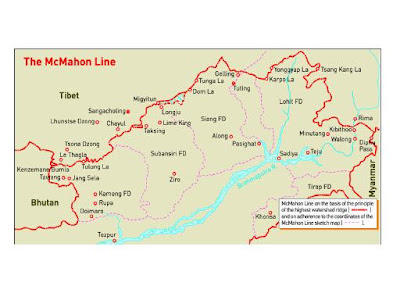
The McMahon Line

The McMahon line is the basis of the Indian claim to the area that was formerly known as the North-East Frontier Agency; and has since become the Indian state of Arunachal Pradesh.
It was drawn with a complete disregard for cartographic techniques and the geography of the area. The scale was - eight miles to an inch.

As Wikipedia makes clear, “The actual treaty map itself is topographically vague (as the treaty was not accompanied with demarcation), and the treaty includes no verbal description of geographic features nor description of the highest ridges.” There is no protocol or scientific method that uses cartographic techniques to identify the geographical location of the line.  The McMahon line was literally a line on paper.
Aksai Chin

Historical claims on the Aksai China area are even more dubious. There has never been any concrete demarcation of this region.


Britain was concerned about Russia's designs in this area, and hence proposed to make the Karakorum Pass as the boundary, so as to again create a buffer between Xinjiang/China and India.

As author Neville Maxwell states,
"In early 1880s, China and India agreed the Karakoram Pass as the fixed point of boundary, while leaving both sides of the pass indefinite. In the mid-1890s, China claimed Aksai Chin as its territory, and voiced the claim to Macartney in 1896, who drew part of the British boundary in the Himalayas. Macartney presented the claim to the British who agreed with his comment that part of Aksai Chin was in China and part in the British territory. Meanwhile, the forward school of British strategist in London suggested that the British should not only include the whole of Aksai Chin, but also all the territory given to Kashmir in 1865." 
In 1899, the British proposed to China that the whole of Aksai Chin would remain Chinese territory and the boundary would be along the Karakorum range; which is the status quo today. The Karakorum pass falls precisely on the boundary of territory controlled by India and China, marking northern end of Sino-Indian border, known as the Line of Actual Control.

However, China didn't reply to this proposal, something which it would regret for years. If it had, the fate of Aksai Chin would have been sealed then and there.
Nehru, for his part, appeared willing to play down the Indian claims to the Aksai Chin. He tried to delay disclosure if the news that the Chinese had built a road in the area. After the news had been revealed, he sought to play down the economic significance of the area, describing it as “barren tundra" and where "not even a blade of grass grows". He even went so far as to cast doubt on the validity of the Indian claim to Aksai Chin.
In statements to the Indian Parliament during early 1959, Nehru pointed out that 
"...during British rule, this area was neither inhabited: nor were there any outposts, .......this place, Aksai Chin area, is distinguished completely from other areas. It is a matter for argument which part belongs to us and which part belongs to somebody else. It is not clear".

Britain's Flip-Flops

Around that time, it was understood by the British government that Tibet forms part of Chinese territory. According to the Anglo-Russian Convention of 1907, both players of the so called ‘Great Game’, Britain and Russia, had decided to negotiate with Tibet only through China. According to the Anglo-Chinese Convention of 1906, Britain was "not to annex Tibetan territory". British Journalist Neville Maxwell states that McMahon had been instructed not to sign bilaterally with the Tibetans if China refused.
But that was exactly what McMahon did, previous promises be damned. Britain and Tibet signed the agreement themselves without Chinese knowledge, and was thus rejected at first by the British government in London. (Later however, its stance seems to have changed; and then changed again, as discussed below). Tibet welcomed this treaty because it would give further credence to what it thought was its ‘sovereignty’, even if it came at the cost of territory. Accordingly, the purpose and content of these exchanges had to be kept secret, and not only from the Chinese.

Britain seems to have taken upon itself the role of Tibet's Guardian. In the 1940s, British officials in India pointed out to Anthony Eden, the then British Foreign Secretary, that China had no rights in Tibet since it had not accepted the provisions of the Simla accord of 1914 (As if it was up to Britain to decide the extent of China's 'right' to Tibet!). Needless to say, the Tibetan government welcomed these intrusions.

Initially, London rejected the Simla accord as it was in contradiction with many previous agreements. But later, in 1935, some hardliners within the government convinced it to start using the line on official maps - thus officially accepting that the McMahon line was the official border between India and Tibet (and hence, later China too).

But recently in 2008, a historic statement was released by the British Foreign Office which would have far reaching consequences. The British government discarded the Simla agreement as an anachronism and a colonial legacy - a "position [the British] took based on the geo-politics of the time".  The British pulled away the only leg India had to stand on.
The statement says,
    ".......our position is unusual for one reason of history that has been imported into the present: the anachronism of our formal position on whether Tibet is part of China, and whether in fact we harbour continued designs to see the break up of China. We do not."
    "Our ability to get our points across has sometimes been clouded by the position the UK took at the start of the 20th century on the status of Tibet, a position based on the geo-politics of the time.  Our recognition of China's "special position" in Tibet developed from the outdated concept of suzerainty. "

(A New York Times article about this statement, entitled, 'Did Britain just sell Tibet?' (as if Britain owned it!) accused the British of 'rewriting history' in exchange for China's support during the financial crisis!)

Effectively, what Britain in fact was saying was that Tibet is a part of China and is not sovereign - which was the position of almost all countries by that time, including EU nations and the US. It even apologized for not having done so earlier. However, what is important in that statement is that the British seem to have completely discarded the Simla agreement - on which the whole of India's negotiating stance is based. Consequently, if we start with the assumption that the Simla agreement was illegal as Tibet had no right to conclude treaties separately, then we arrive at what the Chinese position has been all along! 


The Tibetan question and the cause of the dispute

The fact is that a large part of the border dispute hinges on the uncomfortable question of Tibet's sovereignty. If Tibet was sovereign at the time of the Simla conference, then the treaty is legal and it serves India's cause. If Tibet was not sovereign at that time, then the treaty is illegal and serves China's cause.

Some activists campaigning for a free Tibet often bring up the Simla conference as proof of Tibet's independence. Their arguments are mainly two fold -
a)The Tibetan representative signed the treaty even though he was instructed by the Chinese representative not to sign, a clear indication undermining (Tibetan acceptance of) Chinese suzerainty over Tibet.
b) More importantly, since Tibet concluded a treaty with a foreign power on its own,it was an independent country on that day.

At the time of the Simla conference, although the Tibetan government had driven out all Chinese officials from Tibet after the collapse of the Qing dynasty and declared independence, the Nationalist government did not accept this and neither has the PRC nor any other government.


India had enjoyed certain privileges with regard to Tibet under the Simla Agreement, including those regarding trade and commerce. However, when China 'annexed' Tibet in 1951, India under Nehru recognized it as Chinese territory, thus giving up those privileges and undermining Tibet’s sovereignty (which it may have momentarily enjoyed during the time of the Simla agreement). Thus in a sense the Indian government tacitly admitted that the Simla agreement was effectively illegal, which to this day remains China's official position. In doing so, India weakened its own position with respect to the border dispute.

The Simla agreement was signed between Britain, Tibet and China. Now, from this information, two questions present themselves -
1) If Tibet was sovereign, why was China invited at the conference at all? Why didn't the British negotiate directly with Tibet?
2) If Tibet was not sovereign, why was it invited at the conference? Why didn't the British negotiate directly with China? (In other words, why did China accept to attend a conference where Tibet was represented as a separate party?)

The answer to (1) is that, as stated above, Britain recognised Tibet to be under Chinese suzerainty. Hence, any bilateral agreement that Britain signed with Tibet (without Chinese agreement) would be illegal. (But ironically, that is exactly what the British did)
(2) is a bit more complicated. There are indications that the British had blackmailed the Chinese into attending by threatening to - 

a) withdraw their recognition of the new nationalist government, and,
b) sign the treaty with Tibet alone if China didn't participate, thus acknowledging that Tibet was in fact sovereign. (But later the British did exactly the same thing when China didn't agree to its terms during the conference).

Hence, it is clear that Britain's imperial designs and its policy of 'divide and rule' and double crossing everyone was in effect the cause of the entire dispute.


Conclusion

Surprisingly, in this complicated dispute, China has shown a remarkable tendency to restrain its own claims and even recognize the McMahon line in the eastern sector. It was willing to ignore history and had offered to recognize Indian claims on 74% of the total disputed territory (the eastern sector - currently controlled by India); provided India recognized Chinese claims on the remaining 26% (Chinese-controlled Aksai Chin). In other words, while China had taken a prudent first step and was willing to convert the current status quo 'borders' into the international boundary, India, on the other hand, was (and is) just not willing to even discuss the issue of mutual compromise.
In the western sector the claim is entirely a matter of perspective, as Nehru himself admitted. In the eastern sector, however, the entire disputed territory hinges upon one question - The legality, or not, of the Simla agreement. 
India has had two contradictory stances simultaneously  - a) Not recognizing Tibet's sovereignty and b) Recognizing the McMahon line as the international boundary; and thus the legality of the Simla agreement. However, if a country doesn't recognize Tibet's sovereignty, then consequently it is expected that it would also not recognize the legality of the Simla agreement and the McMahon line. 
The Indian position can also be construed to mean that regardless of whether or not Tibet is sovereign now , it was sovereign when the Simla agreement was signed; and consequently the McMahon line is legal. Which raises the question based on which 32,333 square miles of territory is disputed - Does signing a (bilateral) treaty with a foreign power on its own make a province sovereign?